Problem & why it mattered
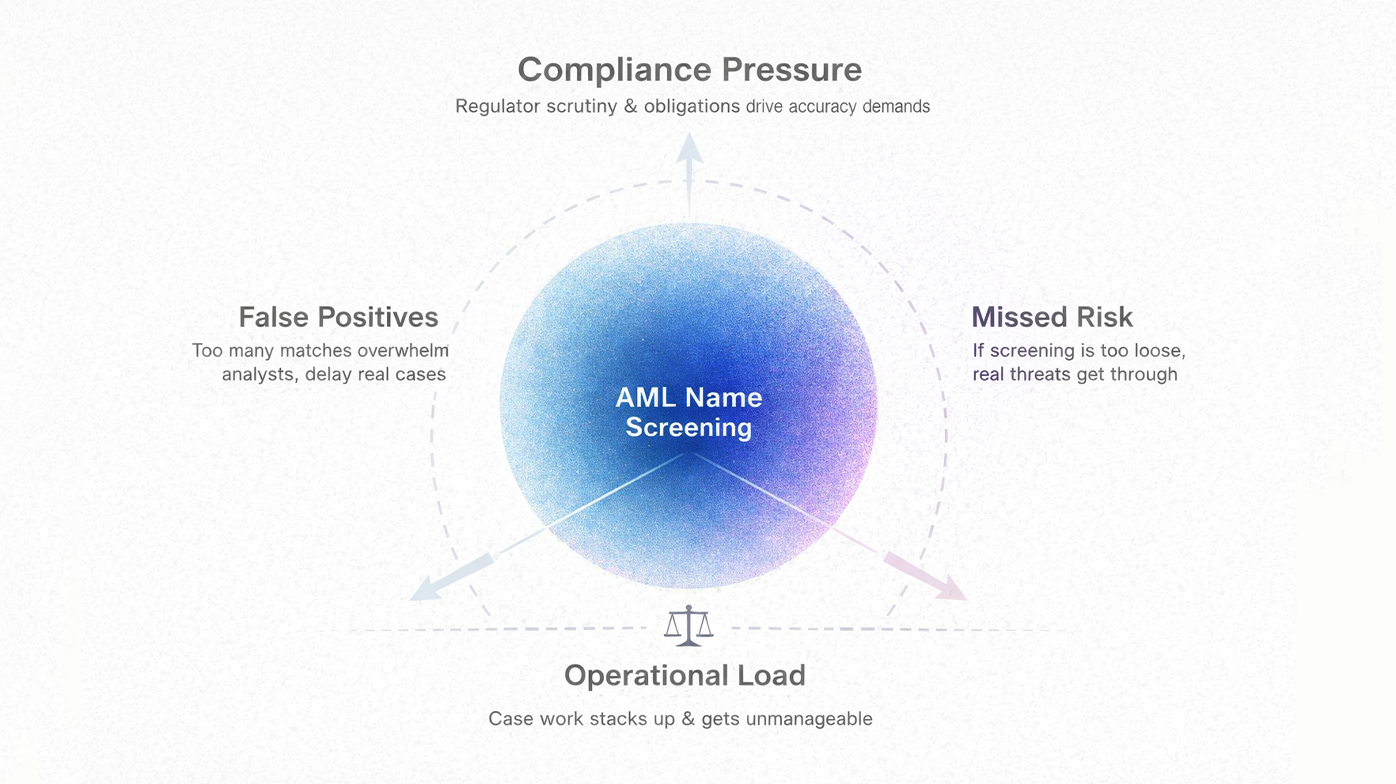
High false-positive hits created operational drag for
stakeholders and increased
regulatory risk.
- The "Silent Failure" of Data Drift:
Inconsistent engine states and
"Point-in-Time" data shifts made tuning results non-reproducible. Calibrating
logic for regional naming
variations was impossible without a stable "frozen" baseline.
- The Operational Risk: Without a stable
laboratory environment, we
risked making tuning decisions on shifting data, potentially leading to missed
sanctions or total manual
review overload.
- Resource Contention: SME (Subject
Matter Expert) velocity was pulled
into emergency L3 production support and "Orphaned Assets" (legacy apps from
other squads). Parallel
high-priority migrations and EOL upgrades added further cognitive load.
Workflow (before → after)
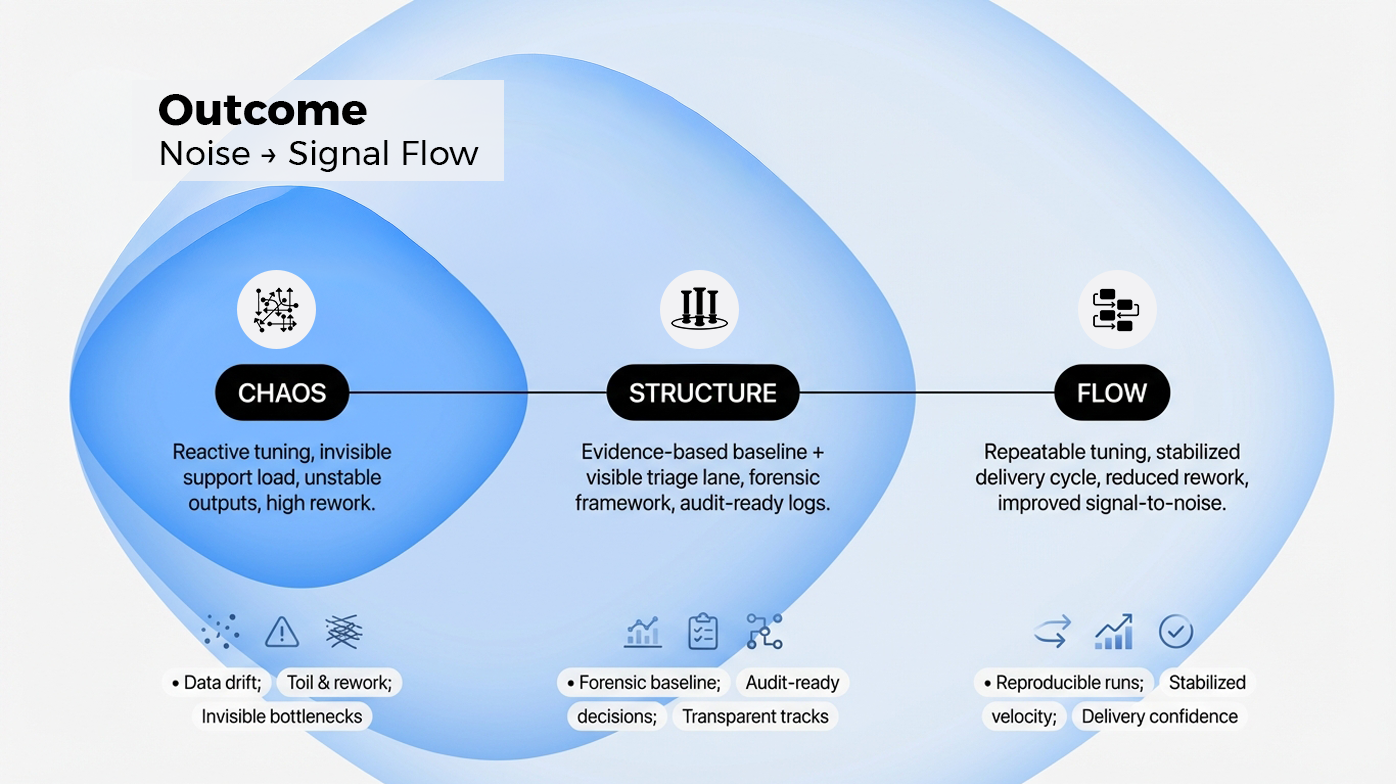
Transitioning from reactive "firefighting" to a forensic,
data-first delivery model.
Tuning based on
contaminated data snapshots → high
rework in end-cycle testing.
Boolean Gap Analysis +
Zero-Test ensuring a stable,
100% reproducible baseline.
SMEs hijacked by invisible
L3 support fires;
velocity stalled.
Explicit Forensic Triage
Lane in Kanban made support
visible.
High noise due to
misaligned regional naming
parameters.
Aligned regional naming
logic with engine sensitivity
parameters.
Reactive culture; 30%+
bandwidth lost to unmanaged
"Dark Matter."
Refined backlog + shielded
velocity reduced delivery
rework by 25-30%.
Approach & Decisions
Structuring a data-driven framework to transform a reactive
environment into a
high-precision delivery pipeline.
What I did (key moves)
- Strategic Discovery: Led a "Double
Diamond" process to map complex
engine logic and design a forensic tuning framework from the ground up.
- The Data Pivot: Identified "Silent Data
Drift"; halted tuning to
resolve inconsistencies via Boolean Gap Analysis, ensuring a stable, 100%
reproducible baseline.
- Operational Shielding: Protected squad
velocity by institutionalizing
a Forensic Triage lane to neutralize support "hijacks" and protect core
development.
- Regulatory Logic: Aligned
Entity-Centric scoring (RP Linking) and
cultural profiles while maintaining an audit-ready Decision Log for authorities.
Decisions / trade-offs
- Data integrity first: Tuning decisions
only proceeded after
reproducible baseline controls were in place.
- Operational visibility over heroics:
Made hidden support load
explicit and triaged to protect planned delivery scope.
- Auditability by design: Maintained
decision logs and risk tracking so
optimization trade-offs remained explainable under compliance scrutiny.
Delivery under Constraints
High-velocity execution despite hyper-utilization and
external dependencies.
Constraints (top 3)
- Forensic Triage: Made untracked
BAU/support work visible (triage lane
+ prioritization rules).
- Asset Repatriation: Offloaded legacy
debt.
- Workstream Orchestration: Balanced
hyper-utilization.
- Quality Guardrails: Minimized
context-switching.
- Active Risk Register: Neutralized
silent blockers.
Impact
Strengthened regulatory confidence and stabilized the
delivery trajectory
for a core AML system, reducing rework by 25-30% through shared
visibility and forensic process
optimization.
Rework Reduction
25-30% decrease in delivery rework
through strategic backlog
management and "Zero-Test" validation.
System Precision
Reproducible baseline across historical runs
(runbook + fixed test set).
Operational Governance
Aligned cross-functional sub-teams and synchronized
downstream dependencies for
stable release flow.
Agile Leadership & System Optimization
Stabilizing the development lifecycle to enhance the
performance of a core fintech
engine.
- Algorithmic Calibration: Improved alert
quality (signal-to-noise) by
reducing false positives in priority scenarios.
- Strategic Prioritization: Stabilized
development flows.
- Operational Governance: Aligned
cross-functional sub-teams.
- System Orchestration: Synchronized
downstream dependencies.
Next improvements (post-launch roadmap)
- Observability: Logs existed, but
insight was hard to surface. Make the
system operationally observable so evaluation can track inputs, outputs, and
drift as quality evolves.
- Governance: Continue strengthening
asset ownership and exit
strategies to keep delivery capacity protected.
Learnings
Strategic takeaways from fintech logic and product
operations.
Operating lessons
- Data Integrity: Tuning is a guessing
game without a forensic data
baseline.
- Visibility: "Dark Matter" kills
velocity; shared visibility aligns
bandwidth.
- Trade-offs: Optimizing a probabilistic
engine means balancing false
positives vs false negatives with audit-ready decisions.
- Governance: Scale requires rigid asset
ownership and clear exit
strategies.
- Observability: Logs existed, but
insight was hard to surface. Make
the system operationally observable so evaluation can track inputs, outputs, and
drift as quality
evolves.
- Trajectory. Success means architecting
the framework and
stabilizing the path.