Problem & why it mattered
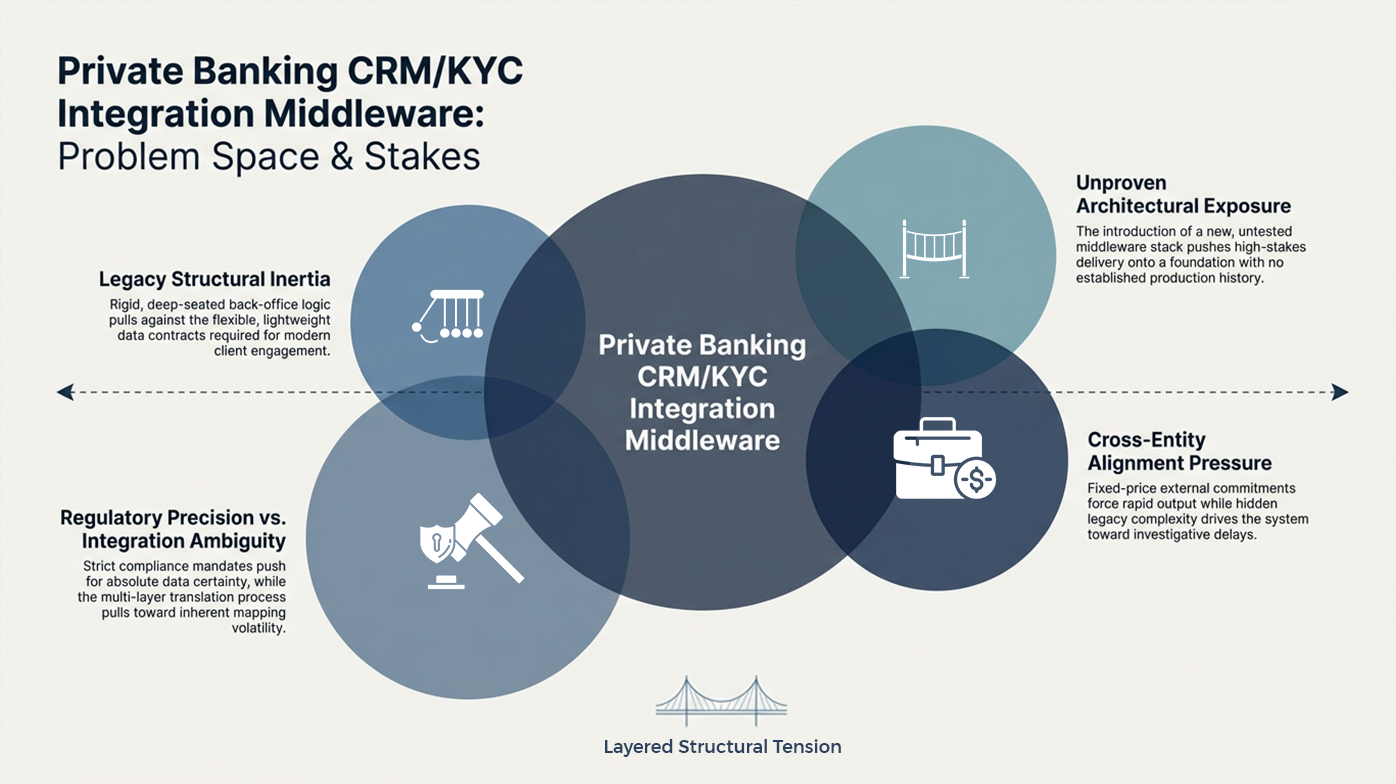
A complex CRM/KYC integration lacked a testable delivery
path—progress was hard to prove and rework risk threatened fixed-price commitments.
Context
- The Mission: Integrate a Microsoft
Dynamics-based CRM/KYC product (Vendor) with legacy back-office logic via secure
APIs.
- The Platform Shift: One of the first
projects to adopt a newly introduced “API Factory” architecture (WSO2) for
production-grade exposure of legacy systems.
What was broken / risky
- Non-testable decomposition: Early
planning fixated on field mapping instead of data normalization + contract-first
schemas, making quality and end-to-end validation hard.
- Architectural uncertainty: The new API
Factory stack had limited production history; teams had to translate dense
COBOL/DB2 structures into stable JSON contracts. This is the same discipline AI
teams need for RAG/ML: clean inputs, stable contracts, and observable failures.
- Stakeholder pressure: Without a
demonstrable “working path,” confidence and decision speed degraded across a
multi-party engagement.
Workflow (before → after)
Shifting from field-level slicing to layer-based, testable
functional delivery.
User stories based on
field counts; low testability until large volumes were mapped.
Layered stories (COBOL →
Java → WSO2); thin slices testable end-to-end as soon as a data path was built.
Roadmap followed a
customer journey (Login → Address) that didn’t align with backend/database
complexity.
Roadmap followed a
technical path—validating simpler routes first to prove architecture and
integration patterns.
Delivery forecasts were
noisy; progress was hard to explain beyond “% fields done.”
Visibility based on
functional milestones and stack readiness—improved predictability and
stakeholder decision-making.
Approach & Decisions
I reframed the roadmap into testable slices, translated
regulatory needs into usable stories, and set a delivery model the team could
execute consistently.
What I did (key moves)
- Regulatory → delivery translation:
Converted KYC/regulatory requirements into actionable user stories with clear
acceptance criteria and API contract expectations.
- Re-architected the roadmap: Pivoted
from a surface-level journey plan to a technical implementation strategy that
de-risked the stack before scaling scope.
- Decomposed stories by layer: Created a
three-layer story structure (COBOL, Java, WSO2) for each feature to enable
vertical-slice testing.
- Data contracts & guardrails:
Defined schema rules, validation checks, and failure modes to keep JSON outputs
stable across layers.
- Thin-slice validation (“Email Pilot”):
Focused the squad on moving one simple field through the full stack to establish
a repeatable “working path” blueprint.
- Stakeholder visibility model: Reported
progress via functional milestones and integration readiness (not raw field
completion), improving decision quality.
Decisions / trade-offs
- Validate foundation before breadth:
Prioritized proving the end-to-end path early—even if it meant delaying broader
feature work in the first sprints.
- Technical path before full journey:
Sequenced work based on integration feasibility and database complexity to avoid
late-stage surprises.
- Right-sized story granularity: Kept
stories meaningful enough to demo, yet small enough to test at each layer and
reduce rework.
Delivery under Constraints
Legacy backend rigidity, a newly adopted middleware platform,
and cross-timezone coordination required a strong delivery operating model.
Constraints (top 3)
- Legacy tech debt: Dense COBOL/DB2
structures (“copybooks”) increased mapping and ETL risk when translating to JSON
contracts.
- Multi-party delivery risk: A
fixed-price engagement across multiple organizations left little room for slip,
misalignment, or rework.
- Global coordination: Aligning teams
across London (CRM Vendor team), Switzerland (Bank), and Singapore
(Implementation) across time zones.
How I reduced risk
- Cadence & quality gates: Introduced
clearer DoR/DoD, acceptance criteria, and contract checks so stories didn’t
“bounce” between layers.
- Governance across layers: Defined
ownership, escalation paths, and acceptance criteria for COBOL → Java → WSO2
handoffs.
- Predictable forecasting: Shifted
estimation from raw field counts to layer complexity, improving planning
accuracy and communication.
- Hands-on unblock & alignment:
Bridged BA intent ↔ engineering feasibility ↔ partner expectations to resolve
trade-offs once, not repeatedly.
Impact
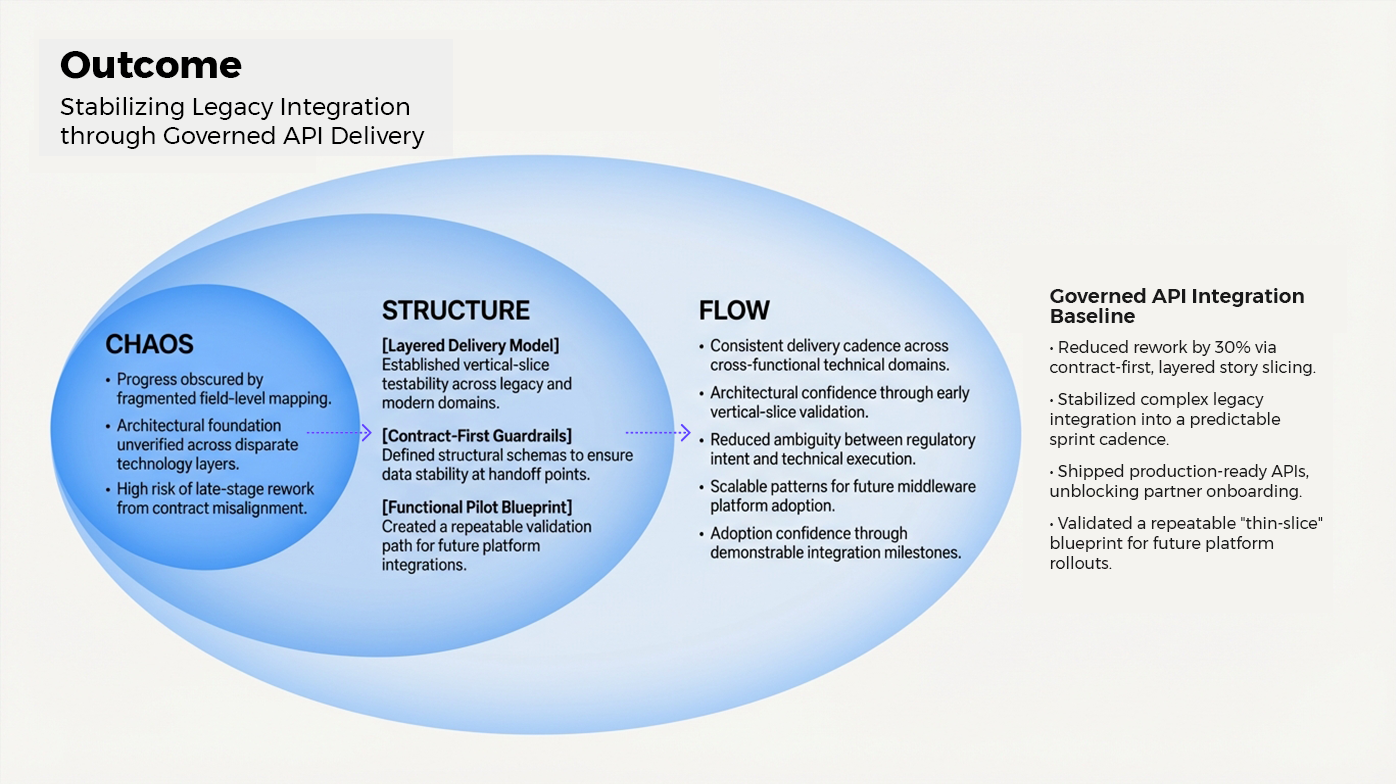
Stabilized delivery for a high-risk CRM/KYC integration and
validated a reusable production approach for the bank’s API Factory stack.
Rework Reduction
Estimated 25–30% decrease in rework
cycles by pivoting from field-counting to a contract-first, layer-based
story structure.
Strategic De-risking
Established a "Thin-Slice"
blueprint (Email Pilot) that proved end-to-end technical
feasibility before scaling feature scope.
Platform Scalability
Validated the "API Factory" operating
model, creating a repeatable pattern for future
legacy-to-modern middleware integrations.
What improved
- Rework: Estimated
25–30% reduction in rework once stories were sliced by layer
with clearer acceptance criteria and contract checks.
- Predictability: Improved sprint
planning accuracy by tracking progress via functional milestones and integration
readiness (instead of “% fields done”).
- Stakeholder confidence: Faster
decisions and fewer escalations after the “working path” (thin-slice) blueprint
made progress demonstrable.
- Platform validation: Established
patterns for using the API Factory stack in production-grade integrations.
- Data quality guardrails: Fewer contract
breaks and clearer failure visibility via contract checks and layer-based
validation.
- Estimation basis: Fewer story
reopens/carry-overs and fewer defect-driven rework cycles after the layer-based
slicing model was adopted.
- Operating model: Established a
repeatable pattern (thin-slice → layer-based slicing → contract checks) for
future API Factory integrations.
Next improvements (post-launch roadmap)
- Developer Experience (DX): Automate
Swagger-to-Confluence documentation to streamline partner onboarding and reduce
manual drift.
- Parallel mocking: Build a mocking
framework so external partners can develop and test UI logic without waiting for
the COBOL layer.
Learnings
Roadmaps must respect the tech stack; a user journey built on
an unproven foundation becomes delivery risk.
Operating lessons
- Deep-tech roadmaps can be technical:
Sequencing by architecture readiness is often the fastest path to real progress
and stakeholder confidence.
- Testability beats throughput optics:
Field-level progress is misleading unless a working end-to-end path exists.
- Stability reduces rework: Clear story
slicing + quality gates (DoR/DoD, contracts, acceptance criteria) are how agile
execution scales in regulated environments.
- AI parallel: Good RAG/ML starts
here—normalized data, stable contracts, and observable failures.